The crime of sky blue
A dress could announce a political allegiance. In his account of the fighting around Chuquisaca, now Sucre, in 1816, Manuel José Cortés describes a city under royalist control, threatened by Manuel Ascencio Padilla’s forces. He then turns from soldiers to women’s clothes.1
“Se castigaba como un grave delito que las mujeres se peinasen con el jopo a la izquierda o llevasen vestido celeste.” Women were punished as if for a serious crime for combing their forelock to the left or wearing a sky-blue dress.1
Cortés published this in 1861, 45 years after the events, without identifying a source for the dress punishment on that page. It is a striking later account of political repression, not a surviving dress decree. It does not tell us that Juana herself wore sky blue.
The uniform in later accounts
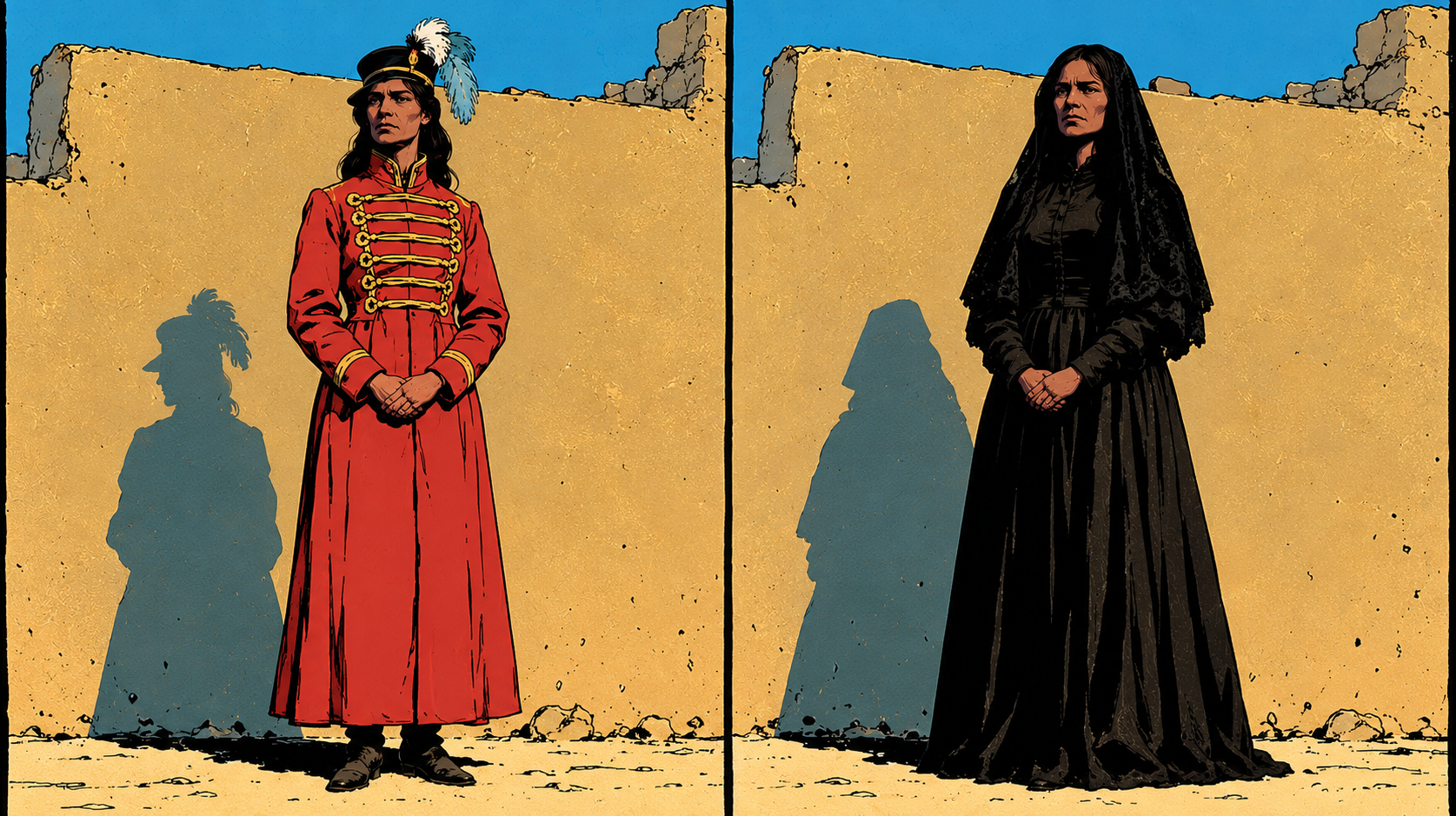
The scarlet tunic and gold braid have a nineteenth-century pedigree. In the 1887 edition of his Historia de Belgrano, Bartolomé Mitre described Juana in battle wearing “una túnica escarlata con franjas y alamares de oro”, a scarlet tunic with gold stripes and frogging, with silver ornaments and white and sky-blue plumes on her cap.3
That is a historian’s description written decades after the war. The footnote points to Velasco Flor for biographical material and explicitly credits him for birth dates; it does not identify a wartime witness to the tunic. The garment may be used in art, but these pages do not establish it as her verified uniform.
In 1918 José Macedonio Urquidi repeated an elaborate costume and described a story about an escort of 25 women as “aunque no está probado”, although it is not proven. His caveat concerns that particular escort, not whether women accompanied Juana at all.4
Where to look instead
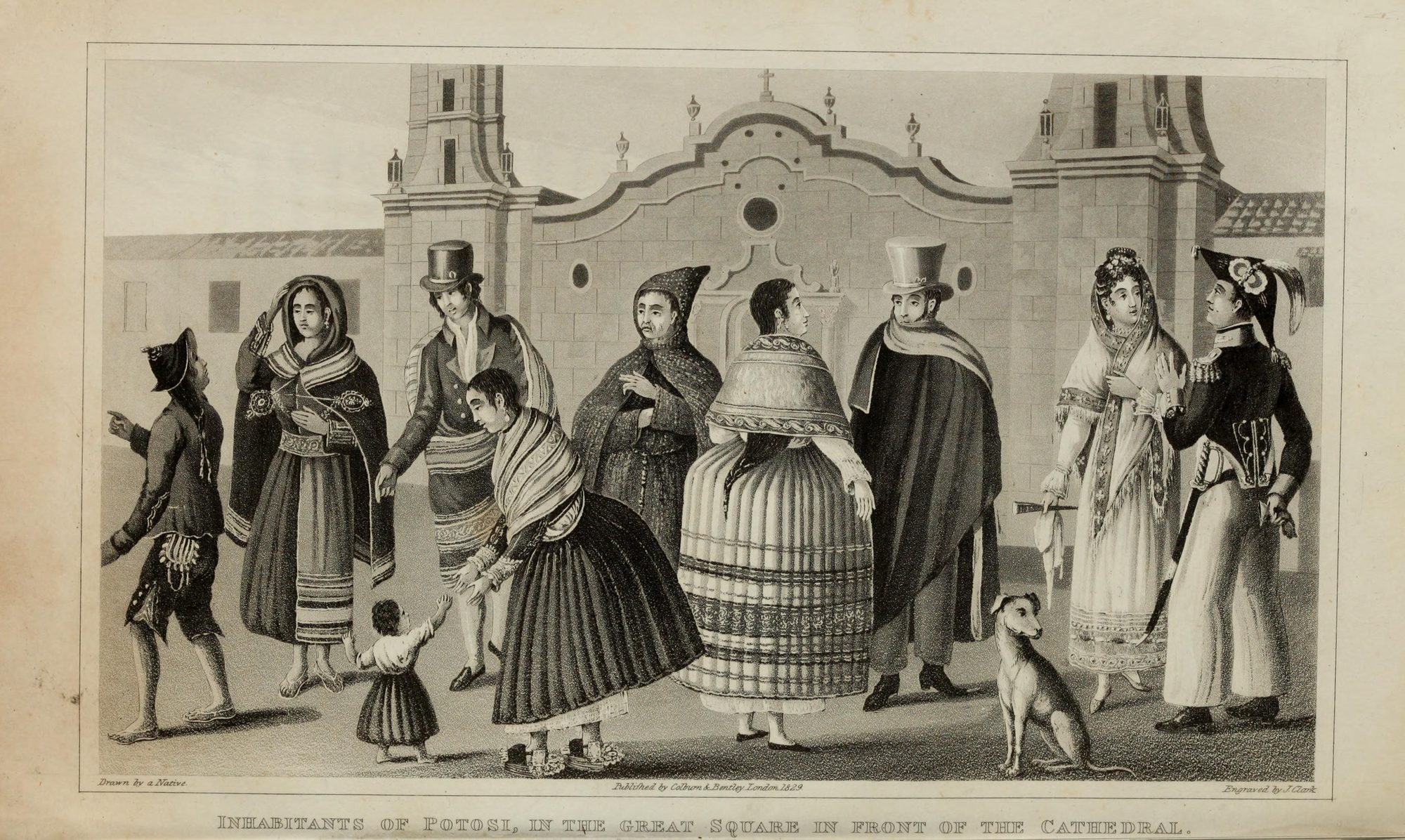
The most useful pictures in this selection come after the fighting. A plate in Edmond Temple’s 1830 travel book shows people gathered in Potosí’s cathedral square. Temple credits a self-taught local artist and explains the different figures, including women from the town and countryside.5
He insisted that “the costumes in every particular are perfectly correct”. That is the traveller’s endorsement, not independent proof. Even so, the picture and its detailed key let us compare garments much more closely than a later heroic portrait does.5
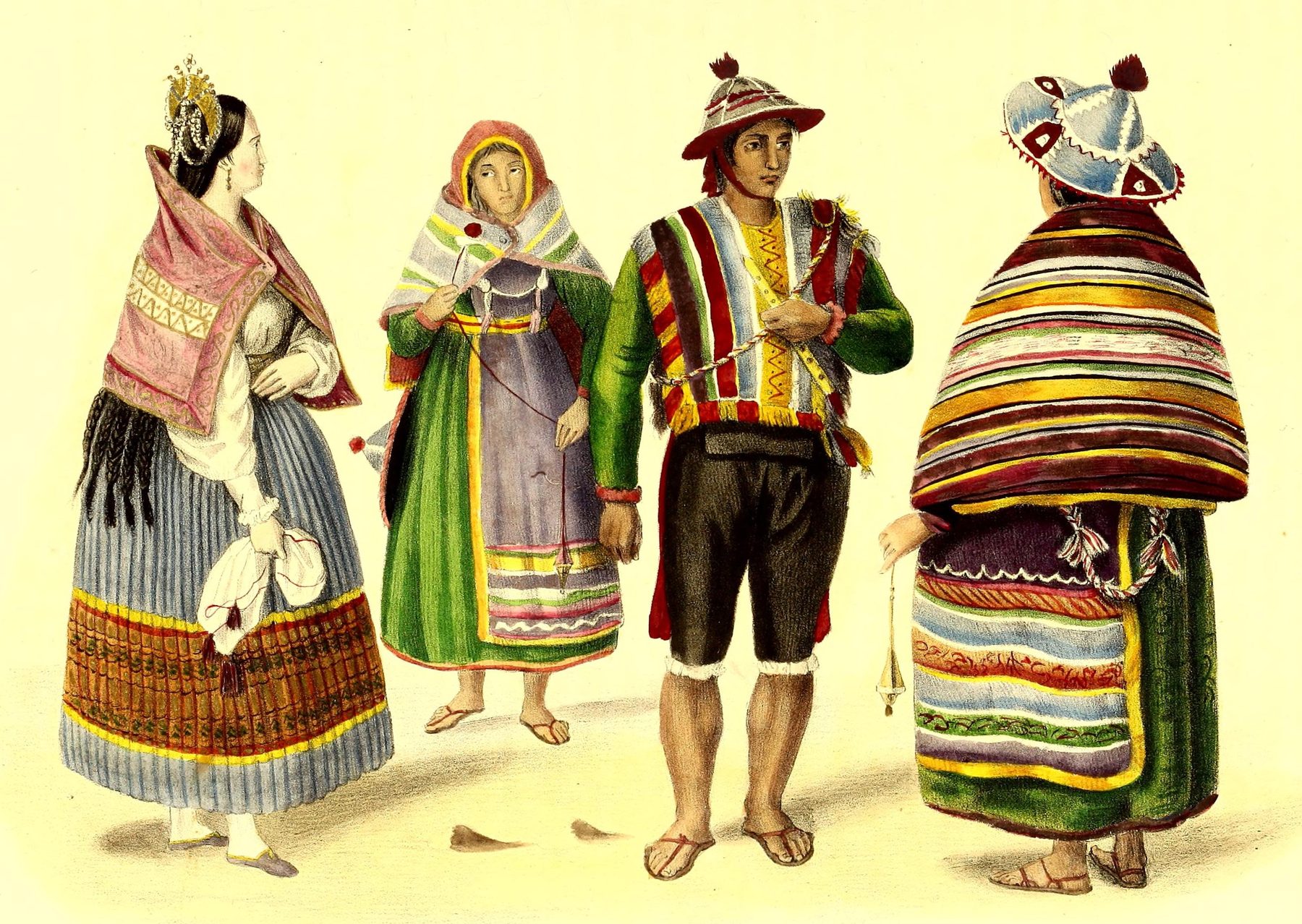
The d’Orbigny plate at the top of this page identifies its subjects as Quechua and mestizo people of Chuquisaca and its surroundings. It is valuable regional evidence, but it was published later still. Neither plate is a portrait of Juana or a picture of her fighters.7
A lady of Chuquisaca
Temple’s description of Chuquisaca in 1826 gives us several ways a woman might dress. Paris fashions were beginning to become general, with new styles arriving through Buenos Aires. For church and processions, he says, women still wore the Spanish basquiña. Elsewhere he describes “the silken basquiña y mantilla” on the promenade: an outer skirt and a covering for the head and shoulders.5
The Potosí plate also shows a woman in a high-waisted white gown. It would be a mistake to treat European fashion as absent from the region, or to turn Temple’s observations into an inventory of Juana’s wardrobe. A basquiña and mantilla are possible choices for a reconstruction; their use by Juana remains an inference.5
Cloth also carried social meaning. Historian Cecilia Moreyra reproduces a Córdoba order that barred Black and mixed-race women from wearing silk mantles, including those married to Spanish men. That is evidence for Córdoba’s racial dress restrictions, not proof of a rule enforced in Chuquisaca.9
On horseback
In Tarija in 1827, Temple praised the women’s horsemanship. He compares their usual riding position with that of English ladies, but describes a small saddle shaped like a man’s, without a supporting crutch. A colourful woollen pellón covered it. At races, he says, men and women rode bareback.6
At Tucumán’s carnival he also saw women riding “in the Amazonian or Turkish seat”. He does not explain the posture more precisely in this passage. These are observations from different places and occasions, not a rule dividing all women by class.5
The sources used here do not settle how Juana sat in the saddle. Showing her astride in battle is an artistic reconstruction, not a detail established by these passages.
A sabre at her waist
A different woman gives us a firmer clue. Historian Esther Aillón Soria examines a court case opened in Tarapacá in 1816 against Gregoria Batallanos, known as la Goyta, who accompanied the guerrilla leader Julián de Peñaranda. Their activities extended through Carangas, Lípez and Tarapacá.10
A witness described her as “vestida de hombre, y con sable a la cintura”, dressed as a man, with a sabre at her waist. Another said people called her “Comandanta y Coronela”. These are allegations in a hostile judicial proceeding, quoted by Aillón, not a neutral costume survey. They nevertheless provide specific contemporary testimony about her clothing.10
Juana’s companions appear in an official letter too. Writing on 26 July 1816, General Belgrano recommended her and mentioned other women who shared “las mismas penalidades”, the same hardships, “cuyos nombres ignoro”, whose names he did not know. He did not describe their clothes.2
Batallanos supplies a comparison for women wearing men’s clothes. She does not establish what Juana’s own companions wore.
The Quechua women
In his report dated 24 April 1816, Padilla says he placed Juana at El Villar “con 30 fusileros y 200 naturales con toda arma”: with 30 musketeers and 200 Indigenous people with assorted weapons. The passage does not identify these 200 as women or specify their language. It cannot serve as a roster of Quechua women fighters.2
For regional dress, Temple is more useful. On his journey towards Potosí he describes Indigenous women wearing skirts and multicoloured shoulder cloths, fastened at the chest with a large silver pin called a topa. His key to the Potosí plate identifies a rural woman’s hide sandals and contrasts them with an urban woman’s decorated shoes.5
The Metropolitan Museum’s study names the Andean shoulder mantle as a lliclla and discusses the pins that held it. It also explains changes in wrapped dresses and overskirts across the colonial period. Those broad histories help us read the pictures; they do not supply one standard outfit for every woman near Chuquisaca in 1816.8
Look at the folded head cloth, striped mantle and round hat in d’Orbigny’s plate. They are details to investigate, with their later date attached. The plate does not justify copying today’s Tarabuco festival outfit into Juana’s war.7
Cholas and mestizas
Temple uses chola as a social and ancestry category. His descriptions also show differences of wealth and occasion; they are not a complete map of how people identified themselves.5
At the Potosí carnival in 1827 he describes a full pleated skirt made with twelve to fourteen yards of velvet or satin, ribbons, a shoulder scarf and braids hanging down the back. Some women wore a narrow-brimmed black hat, which he compared with Welsh women’s hats. This is festive dress observed in 1827, not a field uniform from 1816.6
The pollera itself was not new. Moreyra finds it among women’s basic garments in late-eighteenth-century Córdoba, with cloth and ornament varying by means. That gives an earlier regional comparison, not proof that every pollera had the lavish shape Temple saw at carnival.9
One hat can be ruled out. Lock & Co. dates the original bowler to London in 1849. It belongs well after Juana’s independence campaigns.13
TEST YOUR EYE
Which item is definitely too late for 1816?
Choose an answer.
The mourning dresses
After Padilla’s death in September 1816, Mitre describes Juana attending a council of war “vestida de luto”, dressed in mourning. Again, this is a later historical account.3
Juana Manuela Gorriti gives a more personal recollection. In her 1892 book Perfiles she remembers meeting Juana in Salta in 1822, when she herself was a small child: “con sus largos vestidos de luto y su semblante sereno y meditabundo”, in her long mourning dresses, her face calm and thoughtful. The words are there in the original printing, on page 8. They are a memory published seventy years after the meeting, not a note made in 1822.11
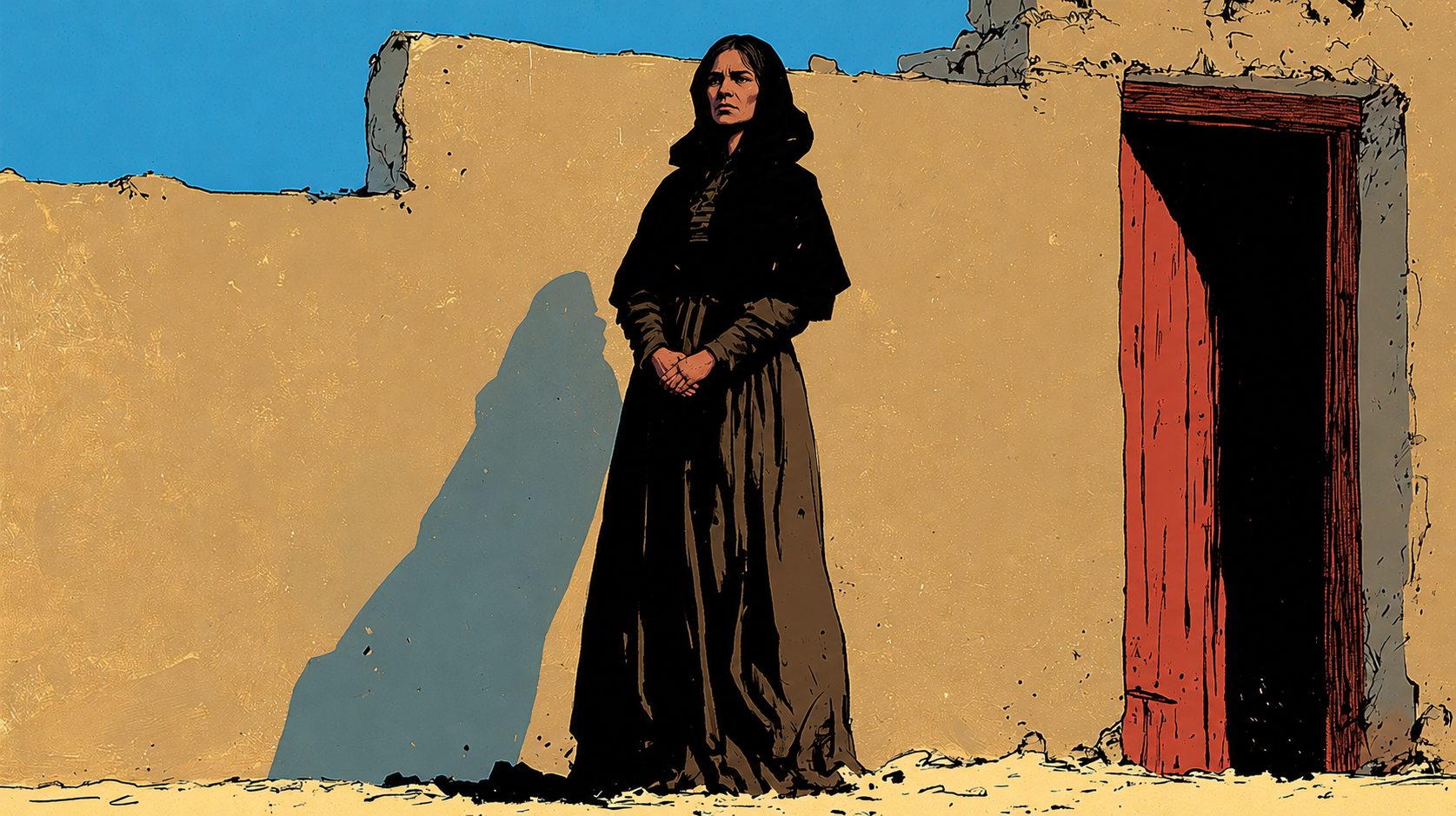
Long mourning clothes therefore have a stronger basis than a precisely reconstructed scarlet uniform. Black is a reasonable visual interpretation; neither passage specifies the fibre or proves an unbroken wardrobe from 1816 onward. A black wool dress would still be an artist’s choice.
Mercado’s women in black, shown here on a sheet dated 14 January 1859 in La Paz, offer a much later comparison. Their clothes cannot establish what Juana wore four decades earlier.12
FOR ARTISTS
What the evidence lets us draw
- A basquiña and mantilla specifically for Juana
- Her exact saddle position
- Men’s clothing for her companions
- Black wool as her mourning fabric
Perkin discovered his synthetic mauve dye in 1856. That rules out the dye in 1816, not every bright purple or pink obtainable from other materials.14
An image with its sources attached
For an Iron Cello illustration, I want to know which details come from a document, which from a later picture, and which I have chosen. The gaps are part of the research. Naming them makes the image more honest.
If you know a picture or a document from Upper Peru in 1809-1825 that shows how women dressed, write to contact@ironcello.com.